
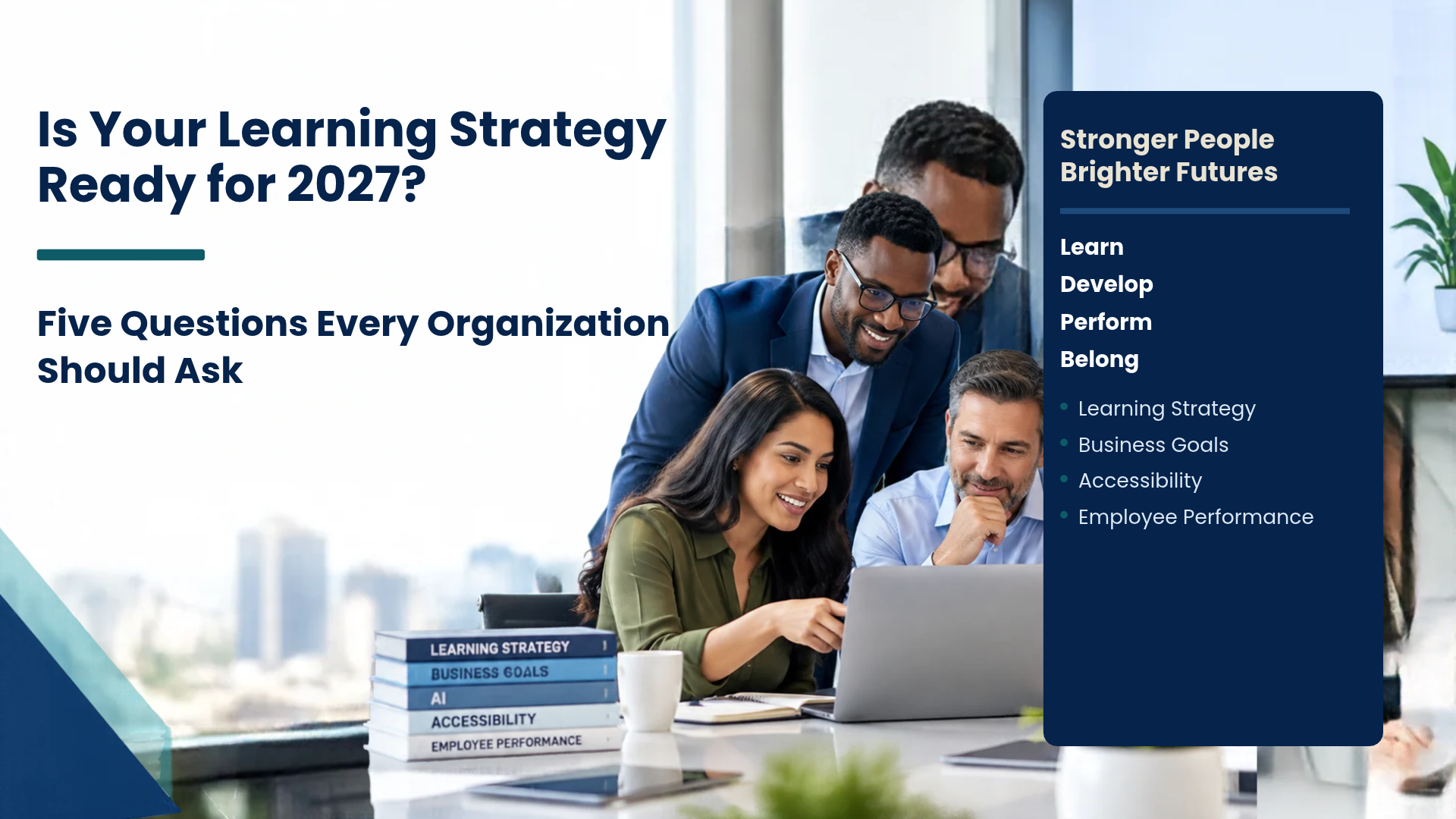
Five Questions Every Organization Should Ask
A new year deserves more than an updated training calendar.
As organizations begin planning for 2027, now is a good time to evaluate whether their learning strategy is truly supporting their business goals.
It's easy to take last year's training calendar, update a few courses, add something about AI, and consider the planning complete.
But here's the question: Are those learning experiences helping employees develop the skills and capabilities they need to be successful?
A training calendar tells you when learning will happen. A learning strategy defines what needs to change, why it matters, and how learning will support business success.
Before you start planning your next training initiative, consider these five questions.
1. Is Your Learning Strategy Aligned with Your Business Goals?
Every learning initiative should begin with a business need.
Maybe your organization is launching a new product, expanding into a new market, working to improve customer service, increasing sales, or focusing on employee retention.
Whatever the priority, the first question shouldn't be, "What training do we need to create?"
Instead, ask, "What do our employees need to be able to do to help us achieve this goal?"
Once you understand the desired behaviors and outcomes, you can determine the best way to support employees.
And sometimes, the answer isn't another eLearning course.
It might be a job aid, a coaching session, hands-on practice, a manager-led discussion, or a combination of learning experiences.
The key is choosing the right solution for the business need, rather than starting with a particular learning format.
2. Do You Know Where Your Employees Need Support?
Before developing new learning experiences, take time to understand where employees are struggling and why.
Employee surveys can provide valuable feedback, but they don't always tell the whole story.
Talk with managers. Review performance data. Look at common mistakes, recurring questions, and areas where employees may be having difficulty.
Then ask yourself whether the problem is related to knowledge, skills, or something else entirely.
For example, if an employee understands a process but struggles to complete it because the system is difficult to navigate, additional training may not solve the problem.
A simple job aid or improvement to the workflow could be far more effective.
Not every performance challenge is a training problem.
Understanding the difference allows organizations to invest their learning budgets where they will have the greatest impact.
3. Are Your Learning Experiences Accessible to Everyone?
Accessibility should never be an afterthought.
Yet too often, organizations develop an entire learning experience and only begin thinking about accessibility during the final review.
By that point, making changes can be time-consuming and costly.
Accessibility needs to be part of the conversation from the beginning.
That means considering how employees will navigate the learning experience, interact with content, access videos, complete assessments, and use assistive technologies.
It also means ensuring your learning materials include appropriate captions, transcripts, color contrast, heading structures, keyboard navigation, and screen-reader compatibility.
When accessibility is built into the design and development process, organizations create learning experiences that are more inclusive and usable for everyone.
If employees can't access the learning, how can we expect them to benefit from it?
As you plan for 2027, make accessibility a standard part of your learning strategy, not something you address at the end of a project.
4. Are You Using AI to Improve Learning or Simply to Create More Content?
AI is creating exciting opportunities for learning and development teams.
It can help organize information, generate initial content drafts, develop scenarios, and streamline certain aspects of the development process.
But just because AI makes it easier to create content doesn't mean we should be creating more of it.
The real opportunity is to use AI to improve how we design, develop, and deliver learning experiences.
That still requires experienced instructional designers, subject matter experts, and quality assurance professionals who understand the audience, the business objectives, and the desired outcomes.
AI-generated content needs to be reviewed for accuracy, relevance, accessibility, and alignment with the organization's needs. Sensitive information must also be protected.
At Tilak Learning Group, we believe technology should enhance the learning experience, not drive the learning strategy.
Start with the learning need. Then determine where AI can add value.
5. How Will You Measure Whether Learning Is Making a Difference?
We often measure training success by looking at completion rates, assessment scores, and learner satisfaction.
Those metrics have value, but they don't necessarily tell us whether employees are applying what they've learned.
If your goal is to improve sales performance, are employees using the new skills during customer conversations?
If you're training employees on a new process, are they completing tasks more accurately and efficiently?
If you're onboarding new hires, are they becoming proficient more quickly?
These are the types of questions that help connect learning to business results.
Before developing a learning experience, determine what success should look like and how you'll measure it.
You don't need to measure everything. Focus on the indicators that demonstrate whether learning is helping employees perform more effectively.
After all, the goal isn't simply to deliver training. It's to improve performance.
Make 2027 the Year of More Intentional Learning
As you begin planning for the year ahead, I encourage you to look beyond your training calendar.
Bring together business leaders, managers, and learning professionals to discuss three things:
- What are the most important business goals for 2027?
- What do employees need to know or be able to do to achieve those goals?
- What learning experiences, tools, and resources will help them succeed?
Then take a look at your current learning programs. Are they supporting those priorities, or are you continuing to deliver training simply because it's what you've always done?
You may discover that some programs need to be updated, others can be eliminated, and new approaches could deliver better results.
A strong learning strategy isn't about how many courses you develop or how many hours of training employees complete.
It's about providing the right learning, to the right people, at the right time, so they can do their jobs more effectively.
At Tilak Learning Group, we partner with organizations to turn business needs into meaningful learning experiences that support employee performance and business success.
As you look ahead to 2027, what's one thing you would change about your organization's approach to learning? We'd love to hear your thoughts.
Michelle’s Take: A training calendar is a schedule. A learning strategy is a decision about what your people need to do differently and why it matters to the business. Make that decision first, and the calendar takes care of itself.
Tilak Learning Group
Strategy • Design • Development • Accessibility • Performance










0 Comments