
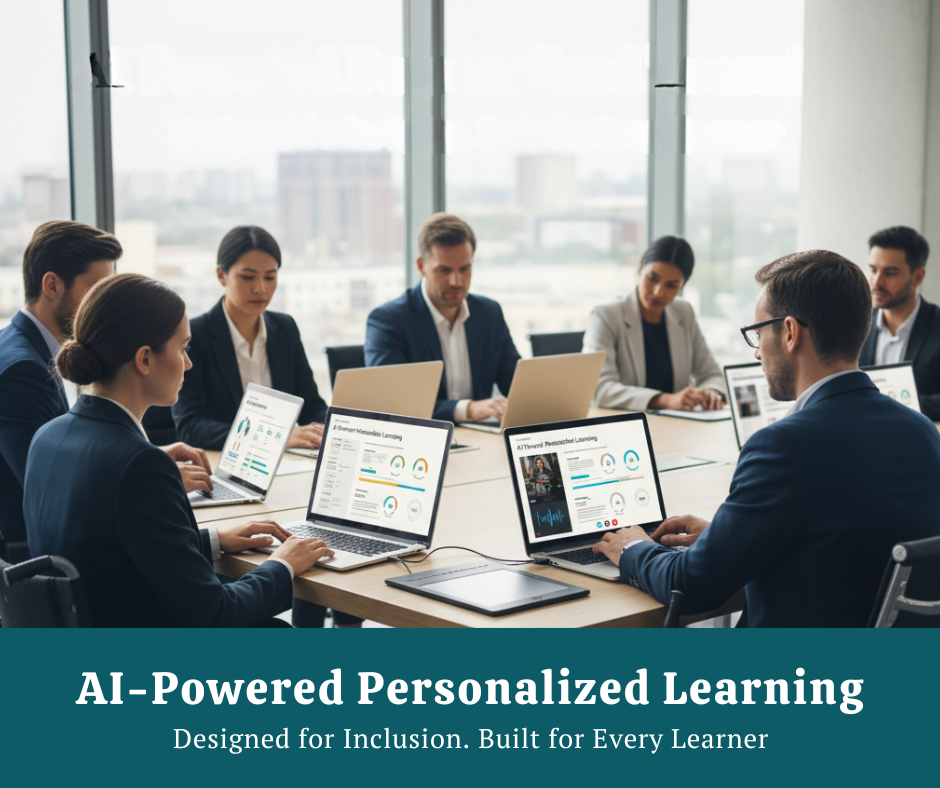
AI-Powered Personalized Learning: The Future of L&D Is Here
Why accessibility and quality assurance matter even more in the age of AI
Creating learning content is getting easier.
That’s exciting.
AI-enabled tools are giving learning teams, subject matter experts, and business leaders new ways to turn ideas and expertise into training faster than ever before.
A process that once took weeks may take days—or even hours.
But there’s an important distinction organizations need to make:
Creating training faster is not the same as creating better learning.
As development speeds up, the questions surrounding the content become even more important.
Is it accurate?
Is it accessible?
Is it instructionally sound?
Does it follow organizational standards?
Is it appropriate for the audience?
Will it actually help someone perform better?
And perhaps most importantly:
Who is responsible for making sure?
A Course Can Work and Still Not Work for Everyone
Imagine a course that passes its technical review.
The links work.
The videos play.
The interactions function.
The quiz calculates the score correctly.
From a technical perspective, everything appears ready.
But now look at the experience through another lens.
Can someone navigate it using only a keyboard?
Are captions accurate?
Can a screen reader interpret the content logically?
Does important information rely solely on color?
Do meaningful images have appropriate alternative text?
Are instructions clear enough for someone encountering the material for the first time?
Suddenly, “Does it work?” becomes a much bigger question.
Accessibility shouldn’t be viewed as something added after development.
It is part of quality.
The Hidden Risk of Faster Content Creation
There is another challenge emerging as AI-generated content becomes more polished.
Professional-looking content can create false confidence.
Something can look impressive while still containing a factual error, confusing instruction, inaccessible interaction, outdated information, poor instructional decision, or inconsistent brand message.
That is why human quality assurance doesn’t become less important when AI enters the development process.
It becomes more important.
At Tilak Learning Group, we see an opportunity for organizations to combine the best of both.
AI can accelerate creation.
People provide context, judgment, strategy, accessibility expertise, and accountability.
The goal shouldn’t be to choose between them.
The goal should be to build a process where they work together.
What Should Quality Assurance Look Like Now?
For enterprise learning teams, QA needs to extend beyond proofreading and checking whether buttons work.
A strong review process should consider several dimensions.
Accuracy: Is the information correct, current, and approved?
Instructional effectiveness: Does the experience actually help people understand, practice, decide, or perform?
Accessibility: Can people with different abilities meaningfully access and use the experience?
Brand consistency: Does the learning represent the organization appropriately?
Usability: Is navigation intuitive? Are instructions clear? Can learners easily determine what to do next?
Business alignment: Does this learning solve the problem it was created to address?
Governance: Who reviews it? Who approves it? Which standards must it meet before publication?
As more people across an organization gain the ability to create learning, these questions become increasingly important.
Technology scales creation.
Organizations also need a way to scale quality.
Accessibility Can’t Be the Last Step
One of the easiest mistakes to make—especially when deadlines are tight—is leaving accessibility until the end.
But many accessibility decisions begin long before final QA.
They happen when someone chooses a color palette.
When navigation is designed.
When an interaction is selected.
When an image is added.
When a video is produced.
When a document is structured.
When instructions are written.
When an assessment is created.
Accessibility isn’t simply a final inspection.
It’s a design decision made again and again throughout development.
And when accessibility is considered from the beginning, organizations often end up with something even better than an accessible experience.
They create a clearer, more usable learning experience for everyone.
The Role of Learning Professionals Is Changing
As AI gives more people the ability to create training, learning professionals have an opportunity to move upstream.
Instead of spending all their time asking:
“How are we going to build all of this?”
They can increasingly focus on:
What should we build?
Who should build it?
What requires professional instructional design?
What can an SME create with the right tools and templates?
What accessibility standards must everything meet?
What requires human review?
What does “business ready” actually mean?
That isn’t a smaller role for L&D.
It is a more strategic one.
AI Created. Human Verified. Business Ready.
At Tilak Learning Group, we believe organizations shouldn’t have to choose between innovation and quality.
AI can dramatically expand who can create learning.
Our role is to help organizations make sure what gets created is effective, accessible, accurate, governed, and appropriate for the business.
That may mean instructional design.
Accessibility reviews.
Quality assurance.
Learning strategy.
Standards and governance.
Or helping an organization determine which projects need professional development and which can safely move through a more streamlined process.
Because the future of learning isn’t about creating the most content.
It’s about creating the right learning—and being able to trust it when it reaches your people.
A Question for Your Learning Team
As content creation becomes faster across your organization, ask one question:
Are our quality systems evolving as quickly as our creation tools?
If the answer is “we’re not sure,” that’s a conversation worth having.
Tilak Learning Group
Imagine Tomorrow. Make It Happen.
Learning Strategy | Instructional Design | Accessibility | Quality Assurance | Learning Governance
Let’s talk about how your organization can create learning faster without sacrificing the quality your people—and your business—depend on.














0 Comments