
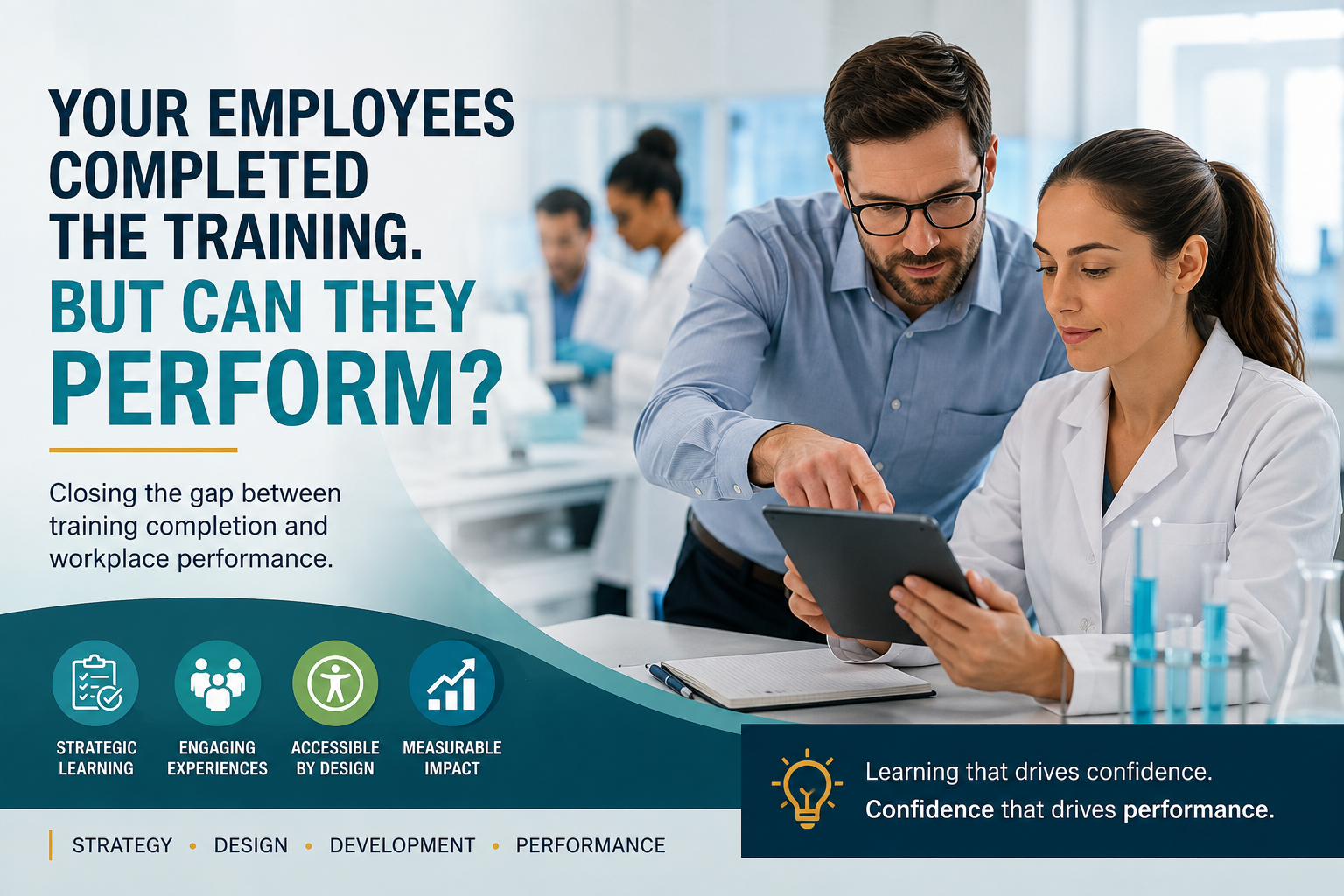
In highly regulated organizations, training completion matters.
Employees need to understand procedures. Compliance requirements must be met. Certifications need to be documented. New systems and processes must be introduced correctly.
But there is a question that matters even more:
Can employees actually perform when it counts?
A learning management system can tell you that 98% of employees completed a course.
It cannot always tell you whether those employees feel confident applying what they learned on the job.
That gap between training completion and workplace performance is where many organizations are beginning to rethink their learning and development strategies.
Completion Is a Metric. Performance Is the Goal.
For years, organizations have relied heavily on familiar L&D measurements:
Course completion
Assessment scores
Attendance
Training hours
Learner satisfaction
Those metrics have value, particularly in regulated industries.
But they don’t tell the entire story.
An employee can complete a course, pass an assessment, and still hesitate when faced with a real-world situation three weeks later.
Why?
Because knowing something and being able to do something are different outcomes.
Effective learning should help employees make better decisions, solve problems, communicate clearly, use systems correctly, follow processes confidently, and respond appropriately when situations don’t go exactly as expected.
That’s when learning begins to influence business performance.
Start With the Business Problem, Not the Course
One of the most important questions an L&D team can ask is:
What do we need people to do differently?
It sounds simple, but it changes the conversation.
Instead of beginning with:
“We need a 30-minute eLearning course.”
Start with:
“What’s happening in the business that needs to change?”
Perhaps employees are making avoidable errors.
Maybe a new process isn’t being adopted consistently.
Managers may be struggling to reinforce expectations.
Sales teams might understand a product but have difficulty communicating its value.
Employees may know the correct procedure but lack confidence using it in a real situation.
Or the problem may not require formal training at all.
Sometimes the right solution is a course.
Sometimes it’s a job aid, manager toolkit, simulation, short video, facilitated discussion, performance support resource, redesigned presentation, or combination of several approaches.
The goal isn’t to create more learning content. The goal is to solve the right problem.
Learning Should Continue After the Course Ends
One of the biggest opportunities for large organizations is designing learning that extends beyond a single training event.
Think about what happens after someone clicks “Complete.”
Do they have an opportunity to practice?
Can they quickly find information when they need it?
Does their manager reinforce the behavior?
Can they ask questions?
Are there realistic scenarios that help them build confidence?
Does the learning appear inside their workflow—or does it disappear into the LMS?
This is where organizations can shift from delivering training to building a learning ecosystem.
A strong learning ecosystem might include formal instruction, practice opportunities, manager reinforcement, accessible job aids, performance support, peer learning, coaching, and resources available at the moment of need.
Learning becomes something employees use, not simply something they complete.
Accessibility Is Part of Performance
Accessibility should also be considered from the beginning—not added as a final compliance check.
When learning experiences are easier to see, hear, navigate, understand, and interact with, they become more usable for everyone.
That means considering elements such as:
Accessible eLearning development
Keyboard navigation
Captions and transcripts
Meaningful alternative text
Color contrast
Accessible PDFs and documents
Clear language
Logical navigation and content structure
Accessibility is especially important for global organizations serving diverse employee populations.
But accessible design isn’t only about meeting standards.
It’s about removing unnecessary barriers between employees and the information they need to succeed.
AI Can Accelerate L&D—But Strategy Still Matters
AI is changing how learning teams work.
It can help accelerate brainstorming, content development, research, scenario creation, personalization, analysis, and content updates.
That creates tremendous opportunities for L&D teams responsible for supporting large and rapidly changing organizations.
But speed introduces a new challenge.
Creating content faster doesn’t automatically create better learning.
AI-generated information still needs context.
It needs human judgment.
It needs review.
And in regulated or highly specialized environments, accuracy, governance, security, accessibility, and subject-matter expertise remain essential.
The question for learning leaders isn’t simply:
“How can we use AI?”
A better question is:
“Where can AI improve our learning workflow without compromising quality, trust, or the learner experience?”
The organizations that answer that question well will have a significant advantage.
Don’t Overlook the Learning Experience
Even excellent information can fail when it’s difficult to consume.
A 70-slide presentation packed with information isn’t necessarily an effective learning experience.
Neither is an eLearning course filled with text simply because every stakeholder requested that their information be included.
Good learning design requires decisions.
What matters most?
What does the learner need now?
What can they reference later?
What should they practice?
What needs to be memorable?
What action should happen next?
Those questions lead to clearer presentations, stronger eLearning, more useful job aids, better virtual learning experiences, and ultimately better employee performance.
L&D Is Becoming a Business Partner
The role of learning and development is evolving.
The strongest L&D teams aren’t simply waiting for someone to request a course.
They’re asking questions.
They’re examining performance.
They’re consulting with business leaders and subject-matter experts.
They’re identifying barriers.
They’re connecting learning initiatives to organizational goals.
And they’re measuring success based on what happens after the learning experience, not simply what happens inside it.
That shift changes L&D from an internal content provider into a strategic business partner.
The Question Worth Asking
If your organization delivers hundreds—or thousands—of learning experiences every year, don’t only ask:
“Did employees complete the training?”
Ask:
“What can they do now that they couldn’t do before?”
And then ask:
“What will help them continue doing it successfully six months from now?”
Those questions lead to very different learning solutions.
And they may be the difference between training that checks a box and learning that changes performance.
How Tilak Learning Group Helps
Tilak Learning Group partners with organizations to transform complex information into learning experiences that are clear, accessible, engaging, and built around performance.
Our work includes:
Learning Strategy & Consulting
Connecting learning initiatives to real business and performance needs.
Custom eLearning Development
Creating engaging digital learning experiences designed around what employees need to do—not simply what they need to know.
Accessibility & Inclusive Learning
Helping organizations develop learning experiences, presentations, and resources with accessibility in mind.
Presentation Design
Transforming information-heavy presentations into clear, compelling communication that helps audiences understand and act.
Virtual & Instructor-Led Learning
Designing facilitated experiences that encourage participation, practice, discussion, and application.
AI & Learning Innovation
Helping learning teams explore practical ways to incorporate AI into their workflows while maintaining human judgment, quality, and purpose.
Performance Support & Learning Resources
Developing job aids, toolkits, guides, and other resources employees can use when they need them most.
For organizations operating in complex, global, or highly regulated environments, learning can’t simply deliver information.
It has to help people perform.
Learn more about Tilak Learning Group at tilaklearninggroup.com.







0 Comments