
SMEs, AI, and speed are changing how learning gets made. Quality needs a clear owner.
Learning creation has changed.
Subject matter experts can build their own modules. AI tools can draft a course outline, quiz, script, and slide deck in minutes. Business teams can publish resources without waiting for L&D.
In many ways, that’s good news.
More people can share expertise. Content can be created faster. Learning can respond to change more quickly.
But it raises a question many organizations haven’t answered yet:
If everyone can build training, who is making sure it works?
Should SMEs Build Training?
Our answer: it depends.
A quick informational resource and a high-risk, behavior-changing learning experience do not require the same development model.
The better question is not “Who is allowed to build?” but “What level of expertise and review does this particular learning need?”
That depends on a few factors:
- What is the risk if the content is wrong?
- How complex is the performance?
- Does the learner need practice?
- What accessibility requirements apply?
- Who reviews the final product?
Sometimes SME self-service makes perfect sense. Sometimes the work needs professional learning design. Sometimes it needs both—an SME who brings the expertise and a learning designer who shapes it into something people can use.
Who Owns Learning Quality?
When we ask who owns learning quality, the most common answer is “everyone.”
That sounds right.
But shared ownership still needs clear roles.
Someone has to know who validates:
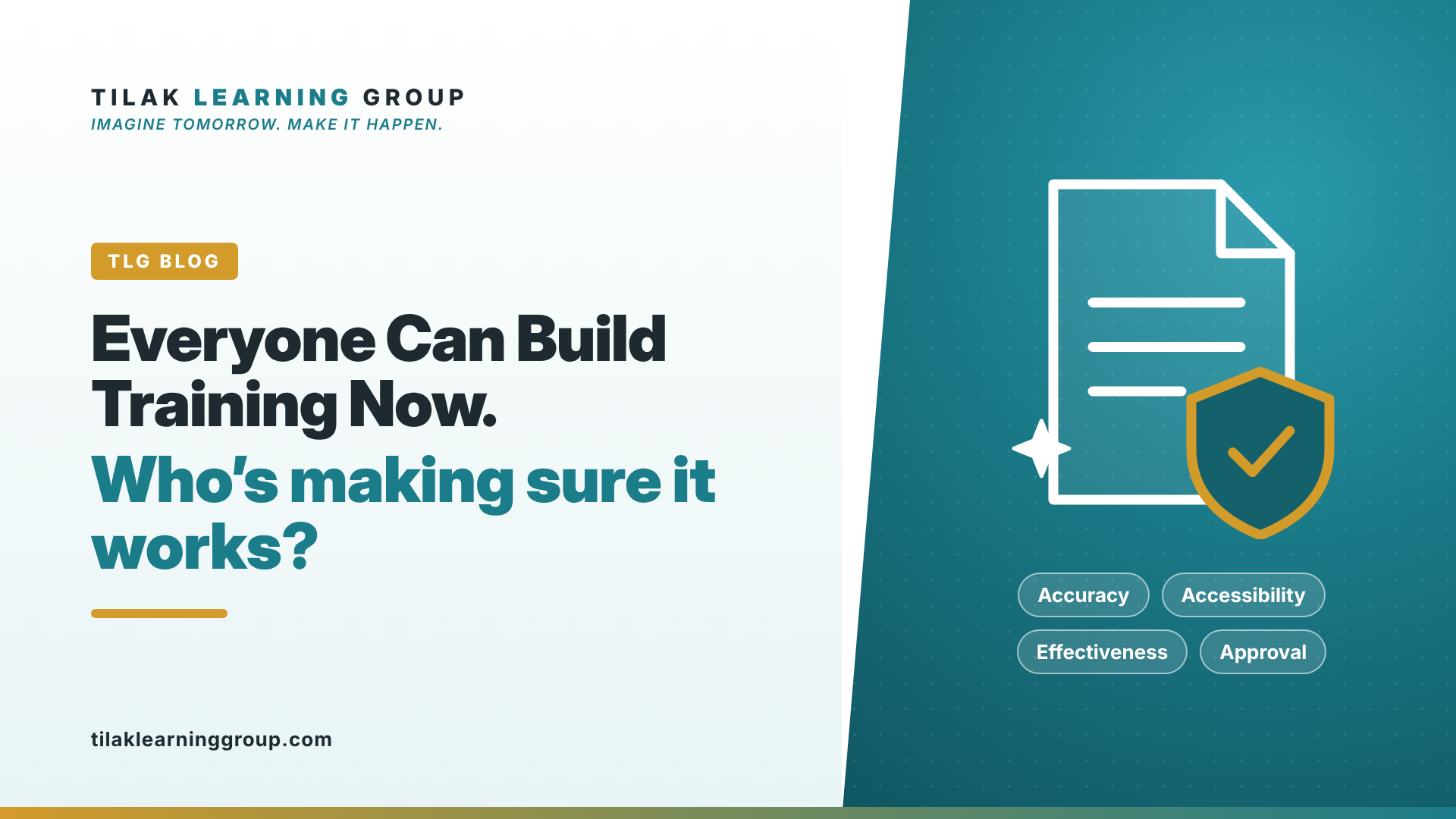
- Accuracy — Is the content correct and current?
- Accessibility — Can everyone use it?
- Effectiveness — Will it change what people do?
- Approval — Who decides it’s ready to launch?
Without those roles, “everyone owns quality” can quietly become “no one owns quality.”
AI Created It. Who Verified It?
AI makes this question more urgent.
As AI becomes part of everyday learning workflows, “generated” cannot automatically mean “ready.”
Someone still needs to check:
- Accuracy
- Accessibility
- Instructional effectiveness
- Brand and policy alignment
- Risk
- Context
ATD has emphasized the importance of governance and keeping humans in the loop for employee-facing learning and other high-risk outputs.
That’s the part of AI adoption we think deserves more attention.
A polished output can create confidence before it has earned it. A clean layout and confident tone don’t tell you whether the content is correct, whether a screen reader can navigate it, or whether learners will actually be able to apply it.
We’d rather define the review standard first, then decide where AI can safely accelerate the work.
Faster Isn’t Better If We’re Solving the Wrong Problem
Speed is valuable.
We’re fans of tools that remove unnecessary work.
But speed is valuable only after we know what deserves to be created.
Before building—by hand or with AI—ask:
- What performance gap exists?
- Why does it exist?
- What needs to change?
- Would training change the outcome?
Those questions can feel like they slow a project down.
In reality, they can prevent weeks of work on the wrong solution.
One question we find especially useful:
“What would success look like if we never built a course?”
It forces everyone to think about the outcome before the deliverable.
Quality Doesn’t End at Launch
There’s one more place quality breaks down: after the course closes.
Most organizations don’t have a training problem. They have a transfer problem.
The learning happens. Then everyone goes back to work.
That’s why we think beyond the course:
Teach → Show → Practice → Coach → Support → Reinforce
Where does your organization usually stop?
If reinforcement depends on the learner remembering to revisit a course, that’s a fragile system. Managers, tools, job aids, and feedback all matter after the event.
A quality learning experience isn’t only accurate and accessible. It’s built to survive contact with real work.
A Simple Governance Starting Point
You don’t need a complex framework to start. Try defining three tiers:
Tier 1 — Quick reference and informational content. SMEs can create with templates, an accessibility checklist, and a light review.
Tier 2 — Skill-building content. SME and learning designer partner together. Includes practice and a defined review for accuracy and accessibility.
Tier 3 — High-risk or behavior-critical learning. Professional learning design, formal review of accuracy, accessibility, effectiveness, and risk, and a clear approver.
Then decide where AI fits in each tier—and what human review is required before anything goes live.
How Tilak Learning Group Can Help
At Tilak Learning Group, we help organizations get the benefits of speed and broader content creation without sacrificing quality.
We partner with SMEs to turn deep expertise into effective learning, build accessibility review into development, help teams set practical quality and governance standards, and design reinforcement that carries learning back into the work.
If your organization is creating more learning than ever and wondering whether it’s working, let’s talk.
Michelle’s Take: Faster isn’t better if we’re solving the wrong problem. Define what good looks like first—then let speed help you get there.
Tilak Learning Group
Strategy • Design • Development • Accessibility • Performance







0 Comments